 INPITTSBURGHWEEKLY
10.27.99~11.03.99 // WWW.INPGH.COM Keeping
It RealINPITTSBURGHWEEKLY
10.27.99~11.03.99 // WWW.INPGH.COM Keeping
It Real
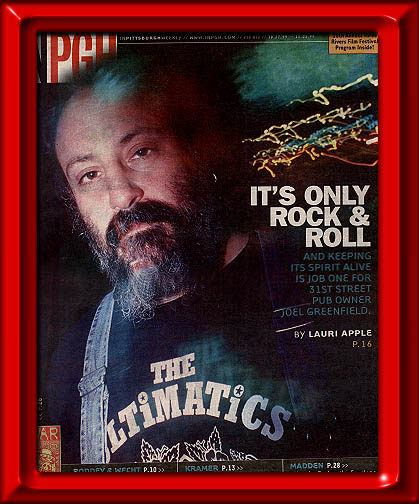
Amid the harsh realities of the music industry, the 31st Street Pub hangs onto the true spirit of rock & roll.
by Lauri Apple
Joel Greenfield crosses his tattooed arms, sits down on a white patio chair
and watches a line of customers filing into his pub. It's a rare moment of
serenity; Greenfield has already been at work for 12 hours, and he's got at
least four more hours of spilled beer, smoky air and raunchy guitar grind
to go.
He's used to hustling 16-hour shifts. "I've been here for 22 years,
and I've got a good thing going," Greenfield says, his
McGruff-the-Crime-Dog voice sliding into a Pittsburgh drawl. "I'm into what
I'm doing, plain and simple."
So are the folks lined up at the door. Some are twentysomething
denizens of Pittsburgh's underground club scene. Others are middle-aged
metalheads or well-dressed professional types. On this particular night,
they've all converged at the 31st Street Pub for a night of no-frills rock
and roll. For a small cover charge, Greenfield gladly delivers.
First, they have to flash photo ID to Alfie Garrett. For four
years, the long-haired, leather-jacketed and lip-pierced doorman has leaned
against the brick facade of the Pub and scanned people's drivers licenses
for birth dates. Intimidating, yes, but Alfie's not a bouncer. The 31st
Street doesn't need security guards.
"People don't get rough here," Garrett explains. His boss's
"respect thy neighbor" policy rubs off on people.
A truck halts at the intersection. "Can you tell me where Bare
Elegance is?" the driver asks. "Make a left and it's to the right," says
Greenfield. A quick thank you and the driver moves along.
Once Alfie made a sign that read, "Directions to Bare Elegance, two
dollars." And people paid - until a band stole the sign and placed it in
their front yard. "I guess they thought it was cool," he laughs.
Many local musicians agree that everything Greenfield does
epitomizes cool. The 43-year old proprietor currently hosts the most
popular underground music venue in the city. Bands who play the 31st Street
Pub share Greenfield's negative attitude towards the commercialization -
and lack of inspiration - often found in today's music industry. They don't
play for money, but for respect.
Though Greenfield hates corporate homogeneity almost as much as he
loves Harleys and tattoos, he doesn't cater to particular underground
cliques. He offers his stage to any band who can bring customers to his bar.
"This is our home," Rob Tabachka says. An off-hours regular,
Tabachka also plays guitar for local metal band Silver Tongued Devil, one
of the 31st's most popular acts. "Though we have to, we don't really care
to play anywhere else."
Other 31st Street performers feel the same way. "There's never been
a place like the Pub," says Sean Finn, whose popular local indie-pop group
Manifold Splendour performs in clubs running the gamut of Pittsburgh's
diverse music scene - from Nick's Fat City in the South Side to Club Laga
in Oakland. Though Finn admits the 31st isn't as popular as those places
and doesn't have as many resources, "they just don't have owners like Joel
working hands-on with musicians," he says. "Joel's as much a part of
furthering the music scene as the musicians."
Several nights a week, both local and national bands climb up on
the 31st's tiny stage and revitalize the spirit of rock in its purest, most
innocent form. Musicians pack their own instruments, charge their own
covers and watch each other's sets. On any given night, Michael Kastelic of
Honeyburst dances to Master Mechanic, Master Mechanic singer Gabrielle
Marsden thanks the Science Fiction Idols for coming and Sci-Fi Idols
frontman Bobby LaMonde hangs out with the audience.
Though the bass usually pounds hard and the cymbals often crash
heavy, the audience doesn't. That's because, while Greenfield admits that
"a little of that shoving bullshit is atmosphere," he hates getting beer
splashed on him just as much as anybody else. So he expects everyone in his
pub to respect one another.
Just as the bands do.
"31st," Greenfield says into a white cordless. It's a minimalist telephone
salutation, but Greenfield isn't into lengthy introductions. Neither is the
band on the other end of the line; they just want a place to play.
Greenfield gets off the phone and chuckles loudly. The band - a
half-German, half-American quartet named the Golden Showers - rings him to
book a show for the next night.
The blatant obscenity of the group's name amuses Greenfield. "I
have no clue who they are, but they sound right up our alley," he chuckles.
At 6 p.m., there's barely anyone in the place. Greenfield chats
with a small group of regular patrons; they reminisce about the days in the
'80s when the 31st was a watering hole for Greenfield's biker buddies.
Those are days that won't come again: When Greenfield decided to turn the
Pub into a concert venue, many of his biker pals abandoned him.
"They told me I sold out," he remembers, "but I'm still me. I'll
ride a Harley forever, but after they quit coming I had nothing to do with
them."
Greenfield knew little about booking bands and putting on shows
until 1995. When the bar's business started slowing down, he modified a
rarely-used dining room into a performance space and hired friends to build
a stage in the back. An adjacent storage room became a resting area and
last-ditch crash pad for out-of-town bands. (When necessary, he lets bands
stay for free.)
At first, bookings were slow. "I used to have to call and call and
call," he says. "No one wanted to come." Then word-of-mouth worked its
magic: Local musicians heard about the pub in the Strip where every show
was promoted, the owner paid the bands and sometimes signed contracts.
Greenfield started getting calls from out of town. If the band was too
esoteric or had no local following at all, he'd refer them to another city.
If they were cutting-edge and somewhat known, he booked them right away.
After four years of experience, Greenfield still sticks to this
no-nonsense policy. Though crowds rarely reach full capacity (about 150),
Greenfield and the bands usually earn enough money to make it worthwhile.
He leaves sound checks and lineup decisions to the bands.
"I keep my nose out of it," he says. "It's better that way." His
only rule is that sound man Jeff Ban receives his 75 dollars up front. The
rest of the money goes to the band.
In today's music industry, Greenfield's fair-and-square approach is
exceptional. Club owners and promoters frequently charge bands for
services, space and promotional activities. Others renege on contracts.
Greenfield knows he could rip bands off and still stay in business, but he
refuses to give in to dirty tactics.
"I don't know if it's greed or what" - the last word lingers a
moment - "that drives promoters to hurt bands. As long as I don't lose
money, I'm happy."
First and foremost, Greenfield is a pub owner, not a booking agent.
Nevertheless, he experiences the same problems that all concert promoters
face. Sometimes bands cancel performances at the last minute, leaving him
with an extra slot to fill. When audiences are sparse, Greenfield has to
pay bands out of his own register.
Location is also an issue: Though situated in the Strip, the 31st
Street Pub is nestled at the high end, far away from the heavy traffic and
pull of Smallman's major clubs. Pedestrians are scarce.
To fight low attendance, Greenfield relies on word of mouth, the
press and the Xerox. When bands send him promotional photos and
information, he mails them off to local papers immediately, hoping the
coverage will bring a few bodies. He also does what few other club owners
would: goes out himself to post flyers in coffeehouses, book and record
stores and popular hangouts.
Sometimes, the extra hassle doesn't seem worth the trouble. More
than a few bands leave their promotional activities entirely up to
Greenfield. "These folks are my friends, but some are lazy," he says. "They
get two good shows, then don't do anything to promote themselves. I make
them flyers - color flyers - and they don't put them up."
Perhaps pessimism is the reason. Greenfield's shows are often too
obscure to draw people outside their neighborhood or suburb and into the
city. For many casual music listeners, "live music" means a big show in a
big room like the Civic Arena or Star Lake Amphitheatre - or at least the
mid-sized Metropol. Underground bands rarely play in front of hundreds of
people; rather, they learn to expect audiences that never reach beyond
their own circle of friends.
"I get too hip sometimes," laughs Greenfield. "I brainwash myself
into believing everyone knows underground music, but most people don't."
Over the summer, the 31st hosted the Get Hip Battle of the Bands, a
three-day showcase of garage punk, hard rock and rockabilly acts. Get Hip -
a record label based in the North Side and organizer of the event -
promoted it heavily. Though one of the most affordable and eclectic
festivals of the summer, turnout was lower than expected. But the biggest
obstacle to attracting larger crowds is apathy.
A glance at statistics generated by Pollstar - a concert
information database - reveals surprisingly low numbers for live music
events nationwide. Though special concerts such as Woodstock '99 and
classic rock arena tours attracted thousands, in 1999 many bands - even
commercial ones with heavy radio airplay - experienced lower ticket sales
than expected.
In Pittsburgh, for instance, popular radio band the Verve Pipe
recently played at Club Laga in Oakland for an audience of two hundred.
Though Joker Productions founder Jon Rinaldo, who coordinates most shows at
Laga, didn't book that particular show, he cites it as an example of how
difficult it can be to draw a capacity crowd.
"It's hard to get people to come out [to a concert]," he laments,
"yet they go to Banana Joe's and it's packed. I don't understand."
Rinaldo can't afford to take many huge risks on unknown acts if
he's going to meet his financial obligation to Laga. Though his crowds
don't always reach the club's full capacity, a high number always looms as
a desired target.
Like Rinaldo, Karl Mullen has seen promising shows flop. As
entertainment director for Next Big Thing Productions - the promotions
agency that books most of the concerts featured at Rosebud and Metropol -
Mullen is responsible for introducing new artists to Pittsburgh and staying
ahead of the national curve. Though many acts draw healthy numbers, every
show is hit-or-miss.
"Music - even the alternative genre - is extremely market-driven,"
he explains. "People need validation, [they need to hear] that what they
like listening to is popular."
In some ways, the 31st Street Pub's small-scale, underground focus
fills a niche that bigger promoters like Rinaldo and Mullen can't. Rinaldo
for one admires the Pub's unique staying power in the local music scene.
Since Greenfield started booking bands, many venues of similar size - the
Next Decade, the Electric Banana and the Upstage in Oakland, Luciano's in
Uptown and Cloud 9 in the Strip - have either shut down or stopped hosting
live music.
The 31st draws its biggest crowds with local favorites like the
Ultimatics, the Silver Tongued Devil, Honeyburst and Submachine. All of
them play the small, loosely-knit club "circuit" that includes the 31st,
Gooski's in Polish Hill, Pluto's in the Strip and the Lava Lounge in the
South Side. All of them acknowledge the 31st is the hub.
"I just do what I got to do," Greenfield says. "If it works, I keep
on doing it."
Steve Boyle and Mike Bonello are puzzled. It's 10 p.m., and only 15 people
have come out for Rickety Thursday. Earlier in the week, they flyered
coffee shops and record stores, sent out listings to local papers and
called friends. Apparently few people got the hint.
"They did the best they could," Greenfield says later. Usually,
Rickety - a collective of several local bands including the Johnsons, the
Viragos and the Working Poor - attracts crowds of 60 or 70. Greenfield
figures most Rickety regulars are either out of town or at Club Laga to
catch "Will Play for Beer," a five-week series of local bands.
Math-rock duo the Double have come all the way from Poughkeepsie,
N.Y. to play for virtually no one. But they don't look depressed; they're
obscure as bands come, and are used to tiny audiences. They set up a drum
kit and guitar and do a quick sound check before plugging into a half-hour
set.
Following the Double is Loveleash, a veteran rock combo fronted by
Duane Irate Jones. A longtime friend of Greenfield's, it was Jones who
convinced the pub owner to host Rickety Thursday after its old home at the
Tobacco Roadhouse shut down.
While Jones grinds his red Fender Elite Stratocaster into powder,
drummer Don Bistarkey and bassist Evan Knauer pound out the rhythm section.
After a tight performance, they're satisfied. "That was something else,"
Knauer says. "Too bad few people saw it."
After three years running, Rickety Thursday is still alive, though
not as unified as it used to be. The collective's organization has dwindled
to just Bonello - who plays bass for the Viragos and the Dirty Faces - and
Boyle, who drums for the Dirty Faces.
When it comes to promoting gigs, they share Greenfield's attitude.
"Joel lets us do what we want," Bonello says, "but if a band does nothing
at all, we don't invite them back."
"Two dollars, please," Boyle says politely to new arrivals. The
price is kept low to get people to come regularly. Unfortunately, the
audience is only one side of the equation; Boyle laments that many Rickety
bands don't attend Thursdays at the Pub anymore. Others don't even return
phone calls.
"There's no community anymore," says Boyle. Nevertheless, he is
optimistic Rickety will survive. Though turnout for the Double/Loveleash
show was dismal, attendance in general is better than ever.
"I talk myself into coming here every week and I look for something
good to happen," he says. "It might just be a bunch of people believing in
what they're doing, but that simplicity can be spectacular."
Like 31st Street, other clubs in town host distinct local "scenes"
as well. Before the Next Decade closed last spring, it played home to
Pittsburgh's thriving rockabilly/alt-country scene, which has found a new
home at the Pollinator in Oakland. The Crane Building and Rosebud in the
Strip, and Zythos and Memphis in the South Side all cater to Pittsburgh's
growing techno crowd. Graffiti in Oakland, traditionally a home to local
and national blues acts, has recently opened its doors to jam and jazz-rock
fusion bands from across the country. And Nick's Fat City in the South Side
regularly features those local bands - the Clarks, the Buzz Poets et al. -
looking to break into the commercial modern-rock radio market.
Though diverse, Pittsburgh's music scenes are also divided. Many
groups of bands blame others for cliquishness or for "selling out" - i.e.,
playing popular venues in front of distracted audiences for economic
reasons.
However, these barriers between club factions don't always grow out
of personal or philosophical conflicts. Sometimes it's a far simpler issue:
The majority of audiences are drawn to what's familiar, so that's what most
venues and promoters seek to provide.
"Most people aren't willing to experiment," says Clarks frontman
Scott Blasey. Unless a band draws a lot of fans, he explains, club owners
and promoters simply won't book them. Without the validation a large crowd
provides, audiences won't seek them out.
Though his band has long pursued the mainstream rock holy grail of
commercial radio airplay, Blasey no less than the more underground
performers tries to keep his focus on the creative aspect of his work. "I
respect anyone who gets on stage and plays original music," Blasey says.
"Whether you're underground or popular, it's tough to get your songs across
if people don't listen."
As for the Rickety crowd, they'll continue at the 31st so long as
interest prevails. Because audiences there do seem to listen. Neither
Bonello nor Boyle can imagine spending a Thursday in another place.
"Joel takes care of the bands here," Boyle says. "He pays them,
stays up front and honest and doesn't screw anyone over."
Bonello chimes in. "Every city needs a rock & roll bar," he says.
"Pittsburgh has several, but the 31st is the best one for us."
Up the street from the 31st Street Pub, the Bloomfield Bridge Tavern fills
with acoustic guitar noise. It's Wednesday - Hellfire Club night at the
BBT. The crowd is a bit older and more sedate than a typical 31st Street
audience, but they're out for the same reason: to hear underground music in
a no-nonsense, intimate setting.
Roughly 30 people have come to see Todd Burge - an acoustic
singer/songwriter from West Virginia - and Nashville legend David Olney.
Sitting two to a table, the audience waits attentively for opener Burge to
adjust his guitar strap. Some sip dollar beers, while others eat plates of
the BBT's legendary pierogies. The room is so quiet one can hear the forks
poking.
Behind the bar, BBT manager Steve Frankowski blames the low turnout
on the rain. Usually, Hellfire night draws a slightly larger crowd. By the
time Olney reaches the midpoint of his set, most people have already gone
home.
Though gracious, Olney is obviously disappointed. "In Pittsburgh,
you have to earn your keep," he says later. "You have to struggle to win
people over. Most of the time, you don't."
After packing up his gear, he sits down on a barstool, stuffs a
guitar pick in his pants pocket, orders a shot of whiskey and chats with
Frankowski. Olney the performer becomes Olney the patron; no one would
guess a New York Times music feature recently named him one of the best
songwriters of the South.
And no one would guess Frankowski had booked him. That's because he
didn't. Whether the musicians playing on the BBT stage are Hellfire acts,
polka bands or local indie rock outfits, Frankowski's job is to refill
customers's empty glasses and man the cash register. Like Greenfield, he's
a bar owner, not a promoter. Other than locking up his sound board after
performances, Frankowski keeps his involvement in shows to a minimum. "I
tell them to turn the knobs their own way," he says.
Every Wednesday evening, Frankowski hands his pub over to the
Ploughman's Lunch, who organize the Hellfire Club programming with poet
Vincent Zepp. Like Mike Bonello and Steve Boyle of Rickety, Mullen,
bandmate Don Roehlich and Zepp book all the bands, coordinate all
promotional activities and keep all the profits. And similarly, they
regularly face low turnouts.
"People don't make intelligent choices," Mullen sighs. He expects
Hellfire crowds to be small; the young series is not a money-maker, but a
labor of love.
Nevertheless, Mullen feels the Pittsburgh music scene is the
healthiest it's ever been. The number of local bands has exploded in recent
years. More importantly, the number of venues has increased dramatically,
from a handful to literally dozens. Every night of the week, bars and clubs
in both the city and the suburbs host live bands.
"Then again," he adds, "the music scene is the healthiest for bands
who make things happen for themselves."
Many bands contact Mullen to play at Metropol or Rosebud. If
they're too esoteric, he refers them to the BBT or the 31st Street Pub,
whose small rooms make more suitable venues for underground bands. He never
worries about causing a rivalry: Frankowski and Greenfield are longtime
friends.
"It's funny how places open and close," Frankowski chuckles, "but
Joel and I are still here. We must be doing something right."
When one needs change, an extra bottle of liquor or a band to play,
the other helps out. In the past three years, Frankowski and Greenfield
have both hosted Bamboozle, a one-night, three-venue festival that attracts
hundreds to watch local music.
When it comes to supporting music, they share the same sentiment:
Treat bands well and they'll come back.
Of course, on most nights Frankowski's regular clientele wouldn't be caught
dead at a 31st Street show. One look at the Golden Showers pretty much
explains why.
Under the light of a blue Molson sign - this is the extent of the
Pub's stage lighting - the band turns the crowd into a semi-circle. Other
than a gold lam� G-string and a pair of white stiletto platforms, the only
thing the lead singer wears is a shaggy haircut.
The rest of band consists of a cowboy drummer, a bass-playing siren
and a sloppy-looking guitarist. They're all a bit freaky, but it's the
virtually naked man who really confounds the audience. Most people have
come to the 31st Street Pub to see local favorites Bunjie Jambo, not a
German guy in heels.
"He's not a drag singer," Ultimatics guitarist Terry Thomas
remarks, "but he's certainly not masculine, either. I don't know what he
is, exactly."
The 31st Street regularly plays host to such strange acts. Garage
band the Demolition Doll Rods, raunch rockers Hot Damn! and local
performance artists the Bull Seal Collective have all graced its stage at
one time or another. Some have achieved national recognition: Nashville
Pussy, one of Greenfield's favorite bands, was nominated for a Grammy
award, and opened for Marilyn Manson at the Civic Arena when last in
Pittsburgh.
While Greenfield occasionally loses acts when they hit it big, he's
got plenty of replacements to draw upon; the pub owner says he's receiving
more mail and phone calls than ever before. And as long as bands don't give
up on Greenfield, he won't give up on them. After 22 years in the bar
business, he figures he'll keep up with the times until he retires.
With four years of booking shows under his belt, he understands
that underground music isn't everyone's favorite niche. Like the guy on his
way to Bare Elegance, most people who drive by the 31st Street Pub are on
the way to somewhere else.
On occasion - whether out of curiosity or on a whim - a few
denizens of the Smallman Street circuit stop, have a beer and mingle. Some
return. Many don't. No hard feelings.
"Everyone's part of a different clientele," Greenfield says. "Most
folks aren't into underground music. You do the best you can do."